
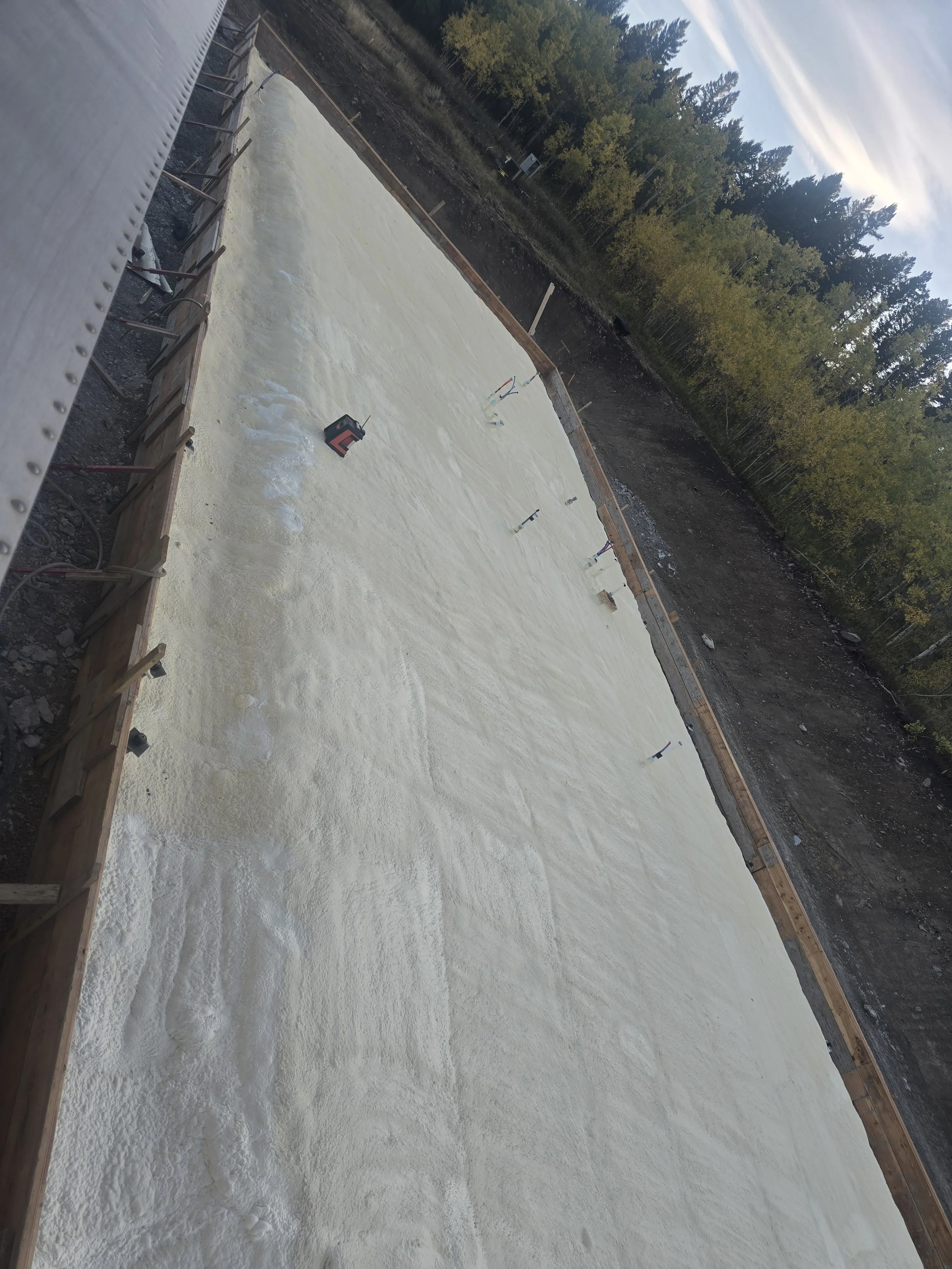
Spray Foam Insulation in Livingston Montana
Epic Foam provides professional spray foam insulation installation in Livingston, Montana and throughout Park County and surrounding Southwest Montana communities. Buildings in the Livingston area face some of the most demanding environmental conditions in Montana, including strong winds, cold winters, and large daily temperature swings. Proper spray foam installation in these conditions requires careful environmental control and a deep understanding of the chemistry involved in polyurethane foam insulation.
Epic Foam specializes in closed cell spray foam insulation for residential, commercial, and agricultural buildings throughout Livingston and Park County. Our work includes insulation systems for custom homes, garages, heated shops, metal buildings, pole barns, and agricultural structures throughout the Paradise Valley and Yellowstone River region. Because every building has different insulation needs, we evaluate each project individually and design insulation systems based on building use, heating patterns, and exposure to Montana’s climate.
Epic Foam is an SPFA member and SPFA PCP certified installer, meaning our installation practices follow the professional standards established by the Spray Polyurethane Foam Alliance. Spray foam insulation is created through a controlled chemical reaction between two liquid components that expand and cure into rigid polyurethane insulation. The quality of this reaction depends heavily on environmental conditions including substrate temperature, humidity levels, and proper material conditioning.
Because of this, Epic Foam approaches spray foam installation as a controlled environmental process, ensuring jobsite conditions are properly prepared before foam is applied.
Environmental Control During Spray Foam Installation
Winter temperatures in Livingston regularly drop well below freezing, and strong winds can quickly remove heat from building structures. These conditions can affect spray foam installation if environmental factors are not carefully controlled.
Epic Foam uses large indirect heaters and environmental conditioning equipment to prepare buildings prior to installation. Indirect heaters allow framing, sheathing, and structural surfaces to be warmed evenly without introducing combustion gases or excess moisture into the building.
During installation we monitor several environmental factors including:
• substrate temperature of framing and sheathing
• humidity levels inside the building
• temperature of foam components
• ventilation and airflow during curing
Maintaining these conditions ensures the foam expands correctly, forms the proper closed-cell structure, and bonds securely to building materials.
Livingston Climate and Wind Conditions
Livingston is widely known for experiencing some of the strongest winds in Montana due to its location near mountain passes and canyon corridors. These winds, combined with cold winter temperatures, can place heavy stress on building envelopes.
A typical winter day in Livingston may include:
Morning temperature
6°F
Afternoon temperature
32°F
Evening temperature
12°F
If a building is heated to approximately 68–70°F, these conditions can produce temperature differences of 35–65 degrees between indoor and outdoor environments.
These temperature differences are referred to as delta-T, which directly affects how heat moves through insulation systems.
Canyon Conditions and Extended Cold Periods
Many properties around Livingston extend into Paradise Valley and nearby canyon environments where buildings can remain shaded for much of the winter day. Structures located along canyon walls or in narrow valleys may receive limited direct sunlight, sometimes not seeing sunlight until late in the afternoon.
Because of this shading and the way cold air settles in canyon environments, outdoor temperatures can remain lower for longer periods of time. Homes or shops heated to 70°F while outside canyon temperatures remain near 5–10°F can experience sustained delta-T differences of 60°F or greater for extended periods.
These prolonged temperature differences increase heat loss through walls and roofs and place additional stress on insulation systems.
Closed cell spray foam insulation helps address these conditions by forming a continuous air barrier and high-performance thermal envelope, maintaining stable performance even during extended cold periods common in canyon environments around Livingston.
Why Spray Foam Performs Better Under High Delta-T
Fiberglass insulation relies on trapped air pockets to slow heat transfer. Under large temperature differences, convection currents can develop inside fiberglass insulation cavities, allowing heat to move more rapidly through wall and roof assemblies.
Closed cell spray foam behaves differently because it forms a continuous air barrier that prevents air movement inside the building envelope.
Advantages of spray foam insulation include:
• reduced air infiltration
• consistent thermal performance
• improved building envelope strength
• reduced condensation risk
• improved energy efficiency
Because spray foam eliminates air leakage pathways, it maintains stable insulation performance even during the large temperature swings common in Livingston and Park County.
Structural Strength and Wind Resistance
In areas like Livingston where strong winds are common, the structural characteristics of closed cell spray foam insulation can provide additional benefits. When spray foam bonds to wall sheathing and framing members, it can increase the racking strength and overall rigidity of wall assemblies.
This added bonding strength can help:
• improve wall shear strength
• reduce movement within wall cavities
• strengthen the overall building envelope
• improve resistance to wind-driven air infiltration
These characteristics make closed cell spray foam insulation particularly well suited for buildings exposed to strong winds and open valley conditions.
Reduced Rodent Intrusion
Another advantage of closed cell spray foam insulation is the reduction of air gaps and openings that rodents often use to enter buildings. Traditional insulation systems can leave small pathways where mice or other rodents can move through wall cavities.
Because spray foam expands and seals cracks, joints, and penetrations, it helps eliminate many of these entry pathways. While no insulation system can completely prevent pests, spray foam insulation can significantly reduce the small openings that rodents commonly use to enter wall assemblies.
This makes spray foam particularly beneficial for homes, shops, and agricultural buildings located in rural areas around Livingston and Park County.
Custom Foam Depth for Each Project
Epic Foam designs insulation systems based on the specific needs of each building rather than applying a single insulation thickness everywhere. Determining the proper foam depth requires evaluating several factors including:
• building heating patterns
• indoor temperature expectations
• roof and wall assembly design
• exposure to wind and sun
• daily temperature swings
Buildings that remain heated continuously during winter—such as homes and heated shops—often require deeper insulation levels to maintain energy efficiency. Agricultural structures or storage buildings may require different insulation strategies depending on their use.
By evaluating expected delta-T conditions in Livingston and Park County, Epic Foam determines the proper foam thickness for each project.
Buildings We Commonly Insulate in Livingston
Epic Foam installs spray foam insulation in many building types throughout Livingston and Park County including:
Custom residential homes
Garages and heated workshops
Metal buildings
Pole barns
Agricultural buildings
Equipment storage structures
Crawl spaces and rim joists
Closed cell spray foam insulation helps reduce heat loss, improve indoor comfort, and control condensation within wall and roof assemblies.
Spray Foam Designed for Park County Buildings
Epic Foam combines industry certification, building science expertise, and specialized equipment to ensure spray foam insulation systems perform correctly in Montana’s demanding climate.
By controlling environmental conditions during installation and designing insulation systems tailored to each building, Epic Foam delivers insulation solutions built specifically for Livingston, Park County, and Southwest Montana.
If you are planning a new build or insulation upgrade in Livingston or anywhere in Park County, Epic Foam can help determine the best spray foam insulation system for your project.
Nearby Spray Foam Service Areas
Spray Foam Insulation Bozeman MT
Spray Foam Insulation Belgrade MT
Spray Foam Insulation Three Forks MT
Spray Foam Insulation Gallatin Gateway MT